
Why Aren't There Robots Cleaning Your Kitchen Exhaust Yet?
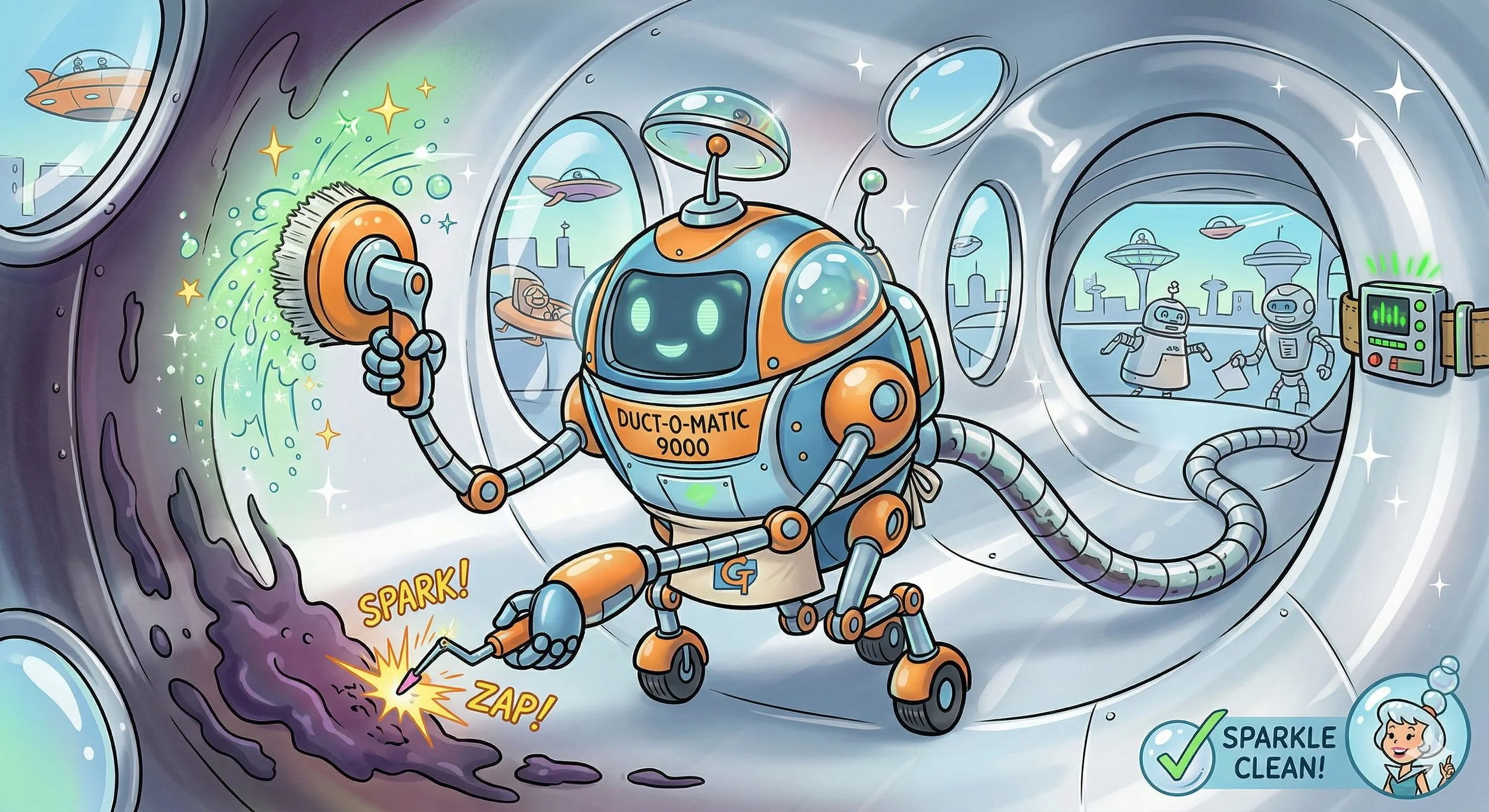
If you manage a hospital, university, or large-scale facility, you’ve probably encountered robots that can vacuum carpets or scrub floor tiles. You might even have seen specialized drones that can brush dust out of HVAC air ducts. It’s natural to wonder why that technology hasn't translated to your kitchen exhaust stacks. The reality is that "cleaning" a standard air duct and "degreasing" a kitchen exhaust system are two entirely different animals. While air ducts deal with dry dust and lint, your kitchen vents are coated in baked-on grease, animal fats, and carbonized sludge. You can’t just brush that away; it’s a combustible fuel source that sticks to metal like industrial glue.
AI generated
The industry has tried to bridge this gap with tools like high-speed spinners and mechanical agitators, but it has yet to crack the code on a truly robotic solution. The hurdles are mostly physical. Kitchen ductwork is a maze of tight 90-degree turns, vertical shafts, and narrow transitions. Most current robots are built for straight runs and struggle to navigate these dead ends or climb vertical sections while dragging heavy hoses. Plus, getting a robot into the duct is a challenge in itself; most access panels are barely large enough for a human hand and a spray wand, let alone a sophisticated piece of machinery.
To truly replace a technician, a robot would need to replicate a very human set of skills that current technology just can't match. A technician doesn't just spray; he uses tactile feedback to feel where the grease is thickest and adjusts his pressure or scraping angle accordingly. To do this, a robot would need a high-torque chassis that doesn't slip on greasy surfaces, a multi-axis arm that can reach around corners, and a waterproof housing that can withstand 200°F water and caustic chemicals. Designing a machine that is small enough to fit in a 12-inch duct but powerful enough to lug a high-pressure hose and scrub with 3,000 PSI of force is an engineering challenge that hasn't been solved yet.
Since we can't easily put a "power-washer on wheels" into these tight spaces, we have to consider alternative methods. We might eventually benefit from robots that don't scrub at all, but instead use high-energy ultrasound to vibrate the grease off the metal or "cryo-blasting" (using dry ice pellets) to freeze and shatter the buildup. Another possibility is the use of "bio-bots" or specialized sprayers that apply enzyme-eating foam that breaks down grease over time, requiring only a light rinse. Until then, the job remains a labor-intensive process of manual scraping and high-pressure washing — tasks that still require a human touch to ensure the ducts are actually clean and fire-safe.